What Is Generative Engine Optimization
In the ever-evolving realm of digital marketing, Generative Engine Optimization (GEO) has emerged as a revolutionary concept that is redefining how businesses, particularly DTCs and e-commerce companies, approach visibility in search. Unlike traditional SEO, which focused heavily on keyword rankings and backlinks, GEO is about making content contextually relevant, AI-comprehensible, and ready for the future of generative search engines like Google SGE, Bing Copilot, and Gemini.
As generative AI becomes more embedded in how users search, GEO represents the intelligent intersection between SEO and machine learning. For direct-to-consumer brands and online retailers, adopting GEO isn't just about ranking—it's about becoming the go-to authority in the exact moment the customer is asking for a solution.
Geo Generative Engine Optimization
Geo Generative Engine Optimization (Geo-GEO) goes one step further by incorporating location-based intelligence, behavioral data, and personalization into content strategies. This emerging practice is especially crucial for DTC and e-commerce businesses looking to dominate both broad and hyperlocal SERPs.
Geo-GEO tailors content not only to the intent of the user but to where they are, what they need right now, and the micro-moment in which they’re searching. That means businesses can serve up the perfect piece of content—whether it’s a buying guide, product comparison, or personalized recommendation—just in time.
Why Traditional SEO No Longer Suffices
The days of stuffing keywords into an H1 tag and waiting for Google to reward you with traffic are long gone. Consumers now demand immediacy, accuracy, and personalization. Traditional SEO lacks:
- Real-time adaptability to context
- Deep semantic understanding
- AI-level personalization
- Integration across multiple platforms and devices
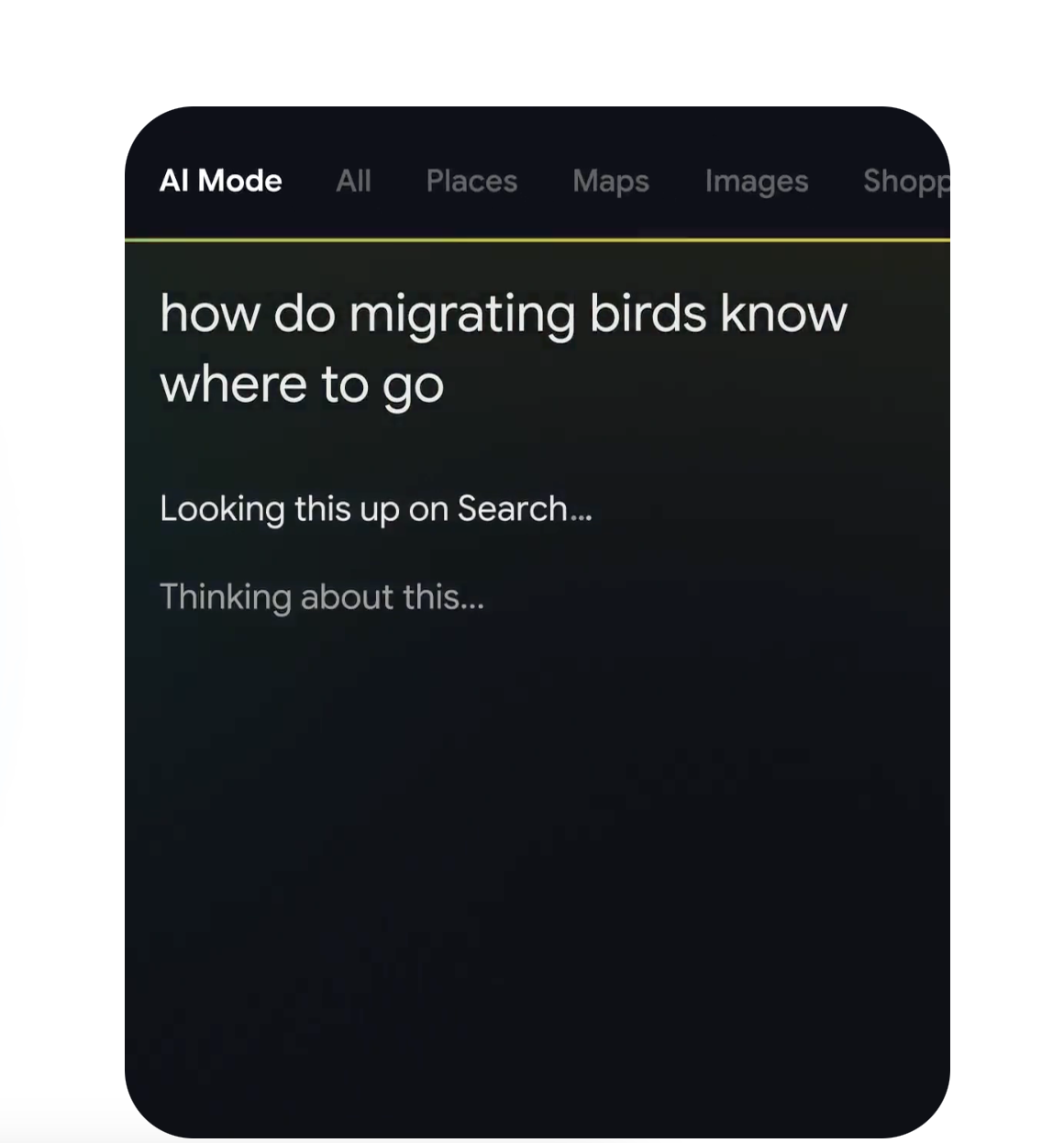
This is where GEO thrives—by aligning content with user intent, geography, device type, voice search, and even mood, in real-time. Here is more information on the new Google AI Mode, the future of shopping. Recent AI Mode research, focusing on volatility, source patterns, and differences from AIO and organic results, highlights how these engines dynamically prioritize sources and adapt responses in real-time, making it crucial for brands to understand these nuances to optimize effectively for generative AI.
How Generative Search Works
Generative search engines operate differently than traditional index-based engines. Instead of retrieving links, they synthesize answers using a combination of:
- Knowledge graphs
- Natural Language Processing (NLP)
- User history and session data
- Multimodal inputs (voice, image, text)
They don't just look for keywords. They understand meaning, context, and user behavior, allowing them to present results that feel more like conversations than static lists.
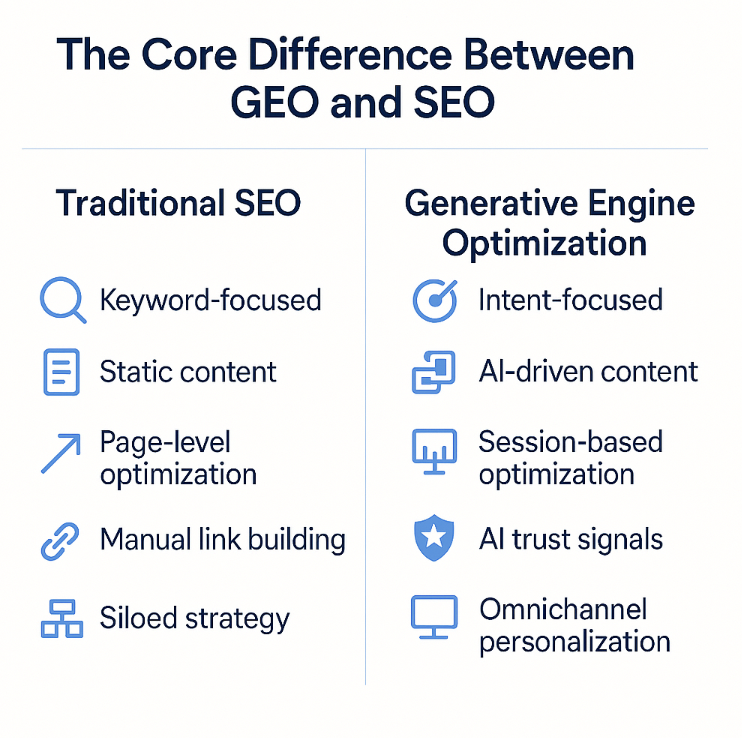
The Core Difference Between GEO and SEO
GEO for DTC Brands: Strategic Advantages
For DTC companies, GEO is a direct path to owning customer moments. Whether it's “best shampoo for oily hair near me” or “what to wear to a beach wedding,” your brand can deliver ultra-relevant, geo-personalized content that feels crafted for the user.
Example:
A skincare brand can use GEO to serve different content to users in Miami (humidity-focused) vs. Denver (dry-skin solutions) even for the same product line.
Content That Feeds the Generative Engines
Generative search engines reward context-rich, modular content. To succeed, your content must:
- Address the "who, what, where, when, why, and how" of a user’s query
- Use structured data (schema markup)
- Include visuals, FAQs, and summarizable blocks
- Be mobile-first and voice-ready
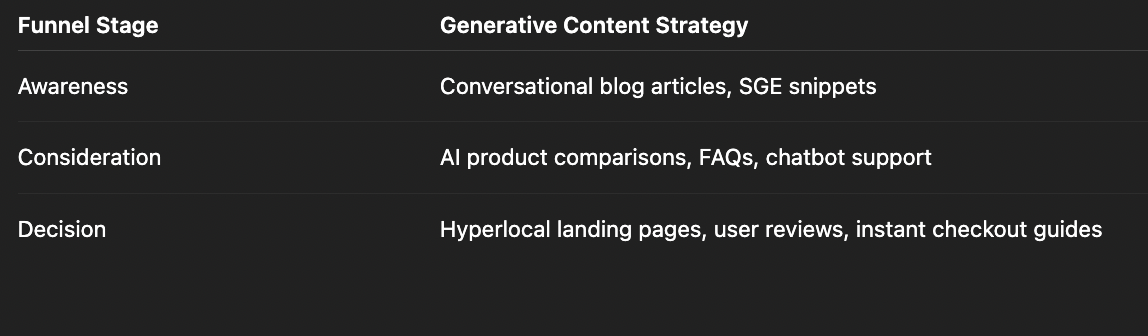
Dynamic Buyer Journey Mapping
In the GEO model, content must align with evolving user intent, adapting in real-time. That means understanding not just your persona, but their journey across devices, locations, and moments.
Example Funnel Using GEO:
Local SEO Meets AI: GEO for Hyperlocal E-Commerce
If you're not showing up when a user in your zip code asks for “best coffee grinder near me,” you're invisible. GEO uses:
- Geo-modified content blocks
- Location-specific FAQs
- Google Business Profiles integration
- AI-based foot traffic prediction
This makes your brand findable and trustworthy in both global and local contexts.

AI Content Strategies for Geo Generative Engine Optimization
To dominate in generative search, you must build content that feeds machine learning models, not just search bots. That means creating assets that are fragmentable, repurposable, and reusable across multiple surfaces like featured snippets, voice assistants, and AI-driven search results. Read more about Generative AI engine optimization for dtc and e commerce.
Here’s how to align your content with GEO:
- Use prompt engineering to generate conversational and instructive content.
- Implement natural segmentation in long-form blogs so answers can be extracted for SERP previews.
- Integrate product-focused microcontent like AI-ready descriptions, pros/cons lists, and buyer intent headlines. Real GEO Use Cases in E-Commerce
Consider how GEO transforms e-commerce for various niches:
Apparel DTC:
Geo-contextual content offers winter coats to users in Chicago and sun hats to Miami shoppers—without changing the URL.
Home Decor Brands:
Generative engines can dynamically serve interior design tips based on regional styles and room types by parsing semantically structured blogs.
Nutrition Products:
Supplements optimized with GEO show up in AI snippets for “best energy booster for altitude” in Denver or “hydration tablets for tropical climate” in Honolulu.
This is where GEO shines: real-time relevance.
Aligning Content with the AI Buyer Journey
A critical shift GEO brings is in mapping content not to static funnel stages, but to searcher behavior during dynamic micro-moments.
Mapping looks like this:
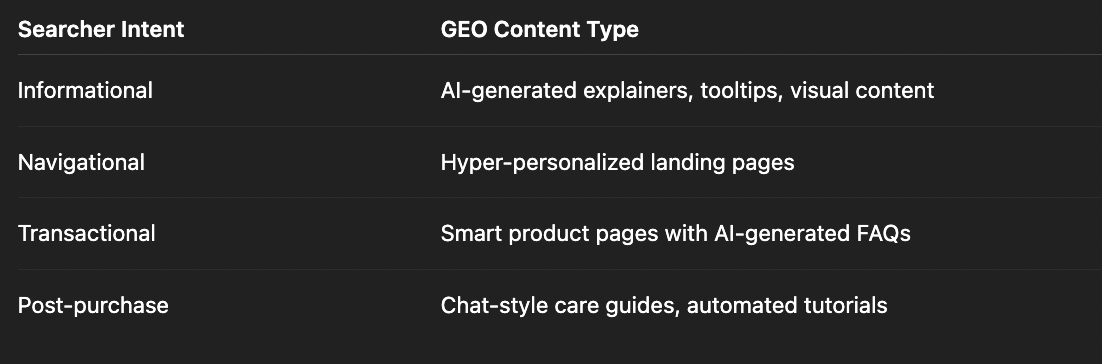
With this model, your content isn't just ranking—it's responding.
Boosting Conversion Rates with GEO Psychology
Generative Engine Optimization doesn’t just improve visibility. It amplifies conversion by:
- Using contextual CTAs aligned with user location and language
- Serving dynamic pricing or urgency cues depending on device, time, and history
- Presenting emotionally resonant language, like “feel fresh in Phoenix heat” vs. “hydrate through NYC’s winter chill”
These micro-adjustments make the macro difference in e-commerce AOV and retention.
Schema Markup: The Unsung Hero of GEO
Want to get your content featured in AI-generated answers? Use structured data. GEO thrives on:
- Product schema (offers, reviews, pricing)
- FAQ schema (optimized for voice search)
- HowTo and Q&A markup
- LocalBusiness schema for brick-and-click hybrid brands
This helps engines understand, contextualize, and deliver your content as direct answers, not just clickable links.
GEO for Images, Video, and Multimodal Search
With the rise of visual and voice search, generative engines demand multimodal content.
GEO Multimedia Strategies:
- Name images contextually:
moisturizer-for-dry-skin-boston.jpg - Add video transcriptions for SEO & voice parsing
- Use AI to generate image alt text and smart captions
Generative engines want to see, hear, and feel your content.
Brand Authority Signals in a Generative World
EEAT (Expertise, Experience, Authoritativeness, Trustworthiness) remains central—but in GEO, these signals are validated by AI itself.
Boost EEAT in a GEO context by:
- Featuring real customer quotes as structured reviews
- Adding author bios with credentials
- Linking to credible sources and data studies
- Creating topical clusters that reinforce brand subject-matter depth
Think of EEAT as the reputation layer generative engines read before surfacing you.
Voice and Multimodal Devices: Optimizing Beyond Screens
With GEO, content should answer:
- “What’s the best blender under $100?” (Text)
- “Show me images of modern farmhouse kitchens” (Visual)
- “What should I wear to a fall wedding in Seattle?” (Context + Fashion + Weather)
Ensure your site loads quickly, sounds natural, and functions across smart assistants.
Creating Pillar Pages for Semantic and GEO Dominance
A well-structured pillar and cluster strategy is critical. Instead of chasing keywords, chase themes.
Example:
Main Page – “Skin Care by Climate”
Sub Pages – “Best Winter Skin Care for Dry Air,” “Tropical Skin Routine Essentials,” etc.
This approach establishes semantic breadth that generative engines trust and use to assemble direct answers.
GEO Technical Checklist
Here’s your high-level checklist:
- Mobile-first indexing
- Page load under 2.5s
- LCP, FID, CLS optimized
- Schema-rich content
- SSL and crawlable structure
- AI-ready meta titles and descriptions
Without technical alignment, your content may be AI-invisible.
GEO + Social Commerce: The Next Frontier
Generative engines are now indexing short-form content and UGC from platforms like TikTok, Instagram, and Pinterest.
GEO Integration Tips:
- Reuse AI content for captions
- Hashtag with intent-rich modifiers
- Link short videos to your blog or product page
- Use smart UTM parameters to personalize retargeting
This connects GEO reach to conversion power.
Conclusion: The Future Is Generative
GEO is not just the next big thing. It’s the thing.
If your DTC or e-commerce brand isn’t planning for generative search, you’re planning to disappear.
The businesses that thrive will be the ones that speak to both humans and machines, understand context before keywords, and deliver value before volume.
FAQs on Generative Engine Optimization
What is generative engine optimization?
Generative Engine Optimization (GEO) is the process of optimizing content specifically for AI-powered search engines that generate answers instead of listing links. It focuses on context, personalization, and machine-readability.
How does GEO differ from traditional SEO?
Traditional SEO targets keywords and backlinks; GEO targets semantic relevance, AI parsing, and user context across devices and locations.
Is GEO only useful for big brands?
No! GEO levels the playing field for DTC and e-commerce brands, enabling smaller businesses to reach local and niche audiences with tailored content.
Can I use GEO and traditional SEO together?
Absolutely. GEO enhances your existing SEO strategy. Think of it as SEO 3.0: smarter, faster, more aligned with how users search today.
Is GEO voice search compatible?
Yes. GEO strategies focus heavily on natural language, FAQs, and conversational tone, making your content perfect for voice-based AI assistants.